Introduction to llms.txt: Managing AI Crawler Access for Your E-commerce Site
Fifty-eight percent of young U.S. consumers now use AI assistants to research products before buying—yet most e-commerce brands have zero control over how AI systems represent them. Learn how llms.txt closes that gap and why early implementation is a competitive advantage that's closing fast.
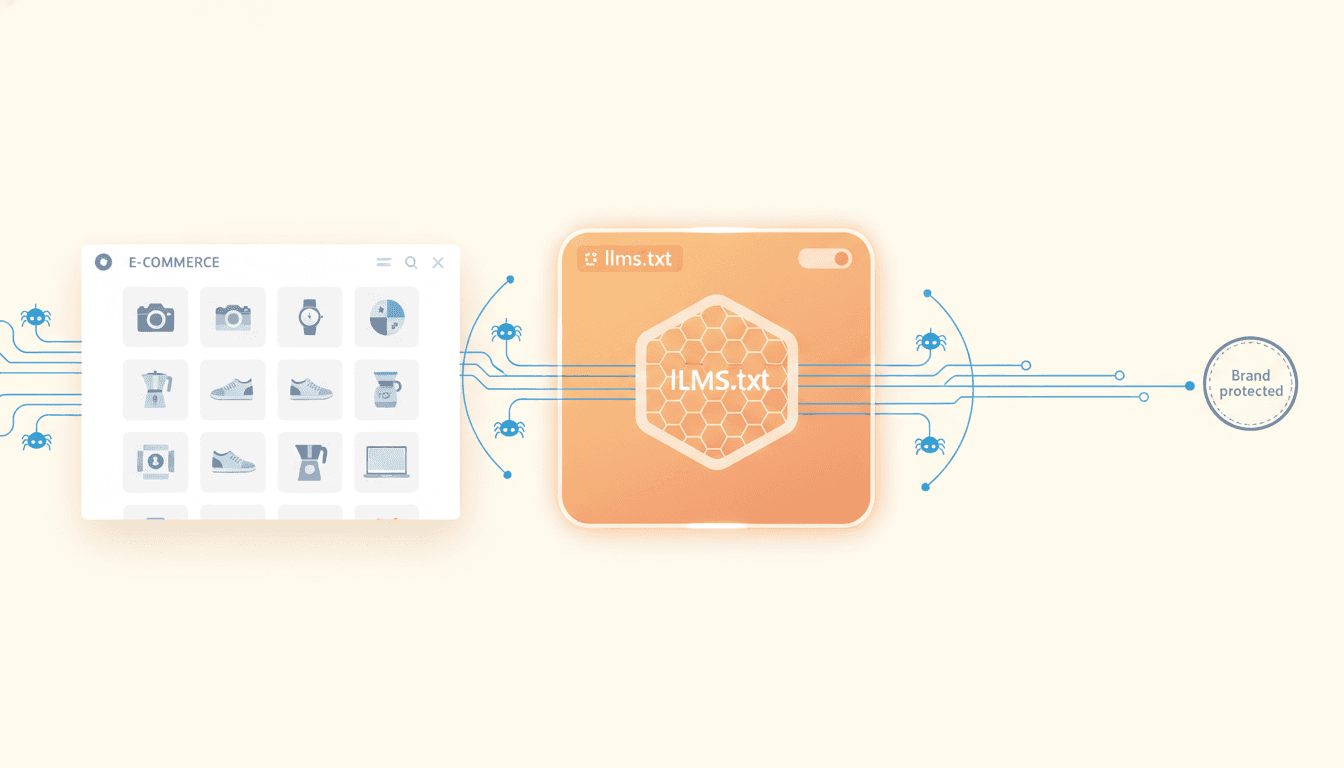
---


# Introduction to llms.txt: Managing AI Crawler Access for Your E-commerce Site

*Fifty-eight percent of young U.S. consumers now use AI assistants to research products before buying—yet most e-commerce brands have zero control over how AI systems represent them. llms.txt closes that gap and represents a competitive advantage that is closing fast.*

[IMG: Split-screen visual showing a consumer using an AI assistant on mobile to research a product, alongside a brand's website with an llms.txt file structure overlay]


---


## The AI Shopping Revolution Is Already Here

Fifty-eight percent of U.S. consumers aged 18–34 now use AI assistants like ChatGPT and Perplexity to research and discover products before buying—[up from just 31% in 2023](https://www.salesforce.com/resources/research-reports/state-of-the-connected-customer/), according to Salesforce. This trend is not a future projection. It is reshaping how consumers discover products right now.

Most e-commerce brands have no control over how—or even if—AI systems represent their products, policies, and brand story. When a consumer asks ChatGPT about shipping policy or a competitor's return window, the AI synthesizes information from whatever it crawled, potentially mixing outdated data, competitor information, or incomplete product specs into the response.

llms.txt addresses this gap directly.

This emerging standard gives e-commerce teams direct influence over AI-generated summaries, product descriptions, and brand context at the exact moment when AI-assisted shopping is reshaping consumer discovery. Early adopters will own the AI-powered commerce space. Competitors who wait will spend years catching up.


---


## What Is llms.txt and Why It Matters for E-commerce

llms.txt is a Markdown-based file placed at the root of a domain that curates and contextualizes a site's most important content for AI crawlers and large language models. [Proposed by Jeremy Howard, co-founder of fast.ai and Answer.AI, in September 2024](https://llmstxt.org/), it emerged precisely because AI crawlers had become functionally distinct from traditional search bots. The file gives website owners a structured way to communicate what matters most about their brand—in a format optimized for how LLMs actually consume and synthesize information.

Before llms.txt, AI crawlers scraped generic HTML without any brand guidance, leading to inaccurate summaries, misrepresented policies, and diluted brand narratives. Jeremy Howard noted that the web was built for humans, and robots.txt was built to manage machine access to it, but LLMs don't just crawl—they synthesize. llms.txt represents the first attempt to give website owners a voice in how that synthesis happens.

For e-commerce brands, this distinction is critical. AI-generated product descriptions, shipping policies, and brand narratives now directly influence purchase decisions in AI-assisted shopping. With [$1.2 trillion in global e-commerce revenue projected to be influenced by AI-assisted discovery by 2027](https://www.mckinsey.com/industries/retail/our-insights/the-future-of-ai-in-retail) (McKinsey), and [72% of Perplexity AI shopping queries resulting in direct citations of brand pages](https://www.perplexity.ai/), the stakes for getting AI representation right have never been higher.

Adoption is accelerating rapidly. As of Q1 2025, over 10,000 domains had published valid llms.txt files—a number doubling approximately every two months since the standard was proposed. The window for competitive advantage is closing fast.


---


## How llms.txt Works: Technical Anatomy and File Structure

The beauty of llms.txt lies in its simplicity. It is written in Markdown—not XML or JSON—making it both human-readable and easy to update without developer intervention. No special tools are required.

The file structure consists of three core components. First, a required H1 title identifies the brand or site name. Second, an optional summary section functions as brand voice guidance, shaping how AI systems describe the company before they read a single product page.

Third, categorized sections of Markdown links organized by content type tell AI crawlers not just where to go, but how to understand what they find. Categorized sections—such as Products, Policies, Brand, and Support—help AI crawlers prioritize and contextualize content in ways that generic HTML simply cannot achieve.

For brands with extensive content libraries, the [llms.txt specification](https://llmstxt.org/) also supports a companion file called **llms-full.txt**, which contains the full concatenated text of a site's most important content. This allows AI models to ingest an entire knowledge base in a single request, without crawling individual pages. Together, these two files represent a significant leap beyond traditional HTML meta tags—offering curator-level context rather than page-level signals.

[IMG: Diagram illustrating the anatomy of an llms.txt file, showing H1 title, blockquote summary, and categorized link sections with arrows pointing to how each element influences AI crawler behavior]


---


## Annotated E-commerce Example: What a Real llms.txt File Looks Like

Here's how a practical llms.txt file might look for a direct-to-consumer apparel brand. Each section is annotated to show how strategic choices guide AI crawler behavior:

```markdown
# Meridian Apparel

Meridian Apparel is a sustainable women's clothing brand offering
size-inclusive activewear, everyday essentials, and outerwear.
All products are ethically manufactured and ship within 2–5 business days
with free returns on orders over $75.

## Products
- [Activewear Collection](https://meridianapparel.com/collections/activewear):
  Full range of performance leggings, sports bras, and tops.
- [Outerwear](https://meridianapparel.com/collections/outerwear):
  Seasonal jackets and coats, sizes XS–4X.
- [Essentials](https://meridianapparel.com/collections/essentials):
  Everyday basics including tees, tanks, and joggers.

## Policies
- [Shipping Policy](https://meridianapparel.com/policies/shipping):
  Delivery timelines, carriers, and international shipping details.
- [Returns & Exchanges](https://meridianapparel.com/policies/returns):
  Free returns on orders over $75; 30-day exchange window.

## Brand
- [Our Story](https://meridianapparel.com/pages/about):
  Founding mission, sustainability commitments, and ethical sourcing.
- [Size Guide](https://meridianapparel.com/pages/size-guide):
  Inclusive sizing chart covering XS–4X with fit recommendations.

## Support
- [FAQ](https://meridianapparel.com/pages/faq):
  Common questions on orders, sizing, and account management.
- [Contact Us](https://meridianapparel.com/pages/contact):
  Customer service hours and channels.

## Additional Resources
- [Sustainability Report](https://meridianapparel.com/pages/sustainability):
  Annual impact data on materials, carbon footprint, and labor practices.
- [Press & Media](https://meridianapparel.com/pages/press):
  Brand assets, press releases, and media contacts.
Several strategic choices stand out in this example. The summary section functions as a brand brief—it shapes how AI systems describe Meridian before they read a single product page. Links point to category pages, not individual SKUs, which prevents AI crawlers from over-indexing on single products while missing the broader catalog.
Policy pages are explicitly linked with descriptive annotations, ensuring AI assistants cite accurate shipping and return information rather than inferring it from cached or outdated data. With five categorized sections—Products, Policies, Brand, Support, and Additional Resources—this structure gives AI crawlers a complete, prioritized map of the brand.
llms.txt vs. robots.txt: Complementary Tools, Not Competitors
One of the most common technical SEO mistakes is confusing robots.txt and llms.txt. They serve fundamentally different purposes, and both are necessary for comprehensive AI crawler management.
robots.txt tells crawlers where they can and cannot go. llms.txt tells AI systems what actually matters about a business. One controls access; the other curates understanding.
The data reveals a striking gap in how brands are managing AI crawlers today. According to a Semrush AI Crawler Adoption Study, 49% of enterprise websites block at least one major AI crawler via robots.txt—yet fewer than 4% have implemented any form of positive AI content guidance like llms.txt. Blocking AI crawlers wholesale may protect certain content, but it also guarantees invisibility in AI-assisted shopping results.
Here’s how the two files work together effectively:
- robots.txt restricts AI crawlers from accessing sensitive pages (admin panels, checkout flows, internal search results)
- llms.txt guides AI crawlers toward the highest-value brand content (product categories, policies, brand story)
- Together, they create a controlled, optimized AI crawler experience that protects sensitive data while maximizing brand visibility
AI crawlers including GPTBot, ClaudeBot, and PerplexityBot currently respect robots.txt directives and are increasingly adopting llms.txt support—making parallel implementation the clear best practice for any serious e-commerce operation.
AI Crawlers in E-commerce: Who’s Crawling Your Site and Do They Support llms.txt?
Four AI crawlers matter most to e-commerce brands navigating AI-assisted discovery as of Q1 2025. Understanding each crawler’s current llms.txt support level helps SEO leads and e-commerce teams prioritize their optimization efforts.
ClaudeBot (Anthropic): This crawler respects llms.txt directives for content curation, with Anthropic’s crawler documentation acknowledging structured content signals as relevant to summary accuracy. As Claude’s capabilities expand into commerce applications, early llms.txt implementation positions brands ahead of the curve.
Google AI Overviews (Googlebot extended): Google’s AI Overviews feature benefits from structured content guidance, and the overlap between traditional SEO best practices and llms.txt implementation makes this a natural extension for existing SEO strategies. Brands already optimizing for search will find llms.txt implementation familiar.
The support landscape is evolving rapidly. Early implementation now positions brands ahead of the curve before llms.txt compliance becomes a baseline expectation across all major AI platforms.
[IMG: Comparison table showing GPTBot, PerplexityBot, ClaudeBot, and Google AI Overviews with their respective llms.txt support status, crawl frequency, and e-commerce relevance scores]
Step-by-Step: How to Create and Implement llms.txt for Your E-commerce Site
Implementation is more straightforward than most e-commerce teams expect. For most brands, the process takes 2–4 hours from audit to deployment. Here’s the complete roadmap:
Step 1: Audit your most important content
Brands should identify the pages that most directly influence purchase decisions—product category pages, shipping and return policies, brand story, size guides, and FAQs. Starting with 5–10 core content categories allows for expansion as strategy matures. Revenue-driving pages should be prioritized first.
Step 2: Create the llms.txt file structure
The file can be created in any text editor and should begin with the Markdown structure: H1 brand name, summary section, and categorized link sections. No special tools or coding experience is required. Notepad, Google Docs, or any standard text editor will work.
Step 3: Write a compelling brand summary
This is the single most important element. The summary guides AI voice and tone across every summary generated about the brand—it should function like a one-paragraph brand brief for AI systems. Key differentiators, policies, and brand positioning should be included. Aim for 2–4 sentences.
Step 4: Organize links into logical categories
Categories should reflect the business model: Products, Policies, Brand, Support, Additional Resources. Only canonical URLs should be included—redirect chains confuse AI crawlers and dilute content signals. Each link should include a brief descriptive annotation explaining what the page contains.
Step 5: Publish to the root domain
The file should be uploaded to yourdomain.com/llms.txt and verified for accessibility. Optionally, a companion llms-full.txt can be created for comprehensive content guidance. Pages that directly impact revenue—product pages, shipping and return policies, and customer reviews—should be prioritized.
Step 6: Monitor and update regularly
Server logs and AI search referral tracking should be used to monitor crawler access. The file should be updated whenever products, policies, or brand messaging evolve—a stale llms.txt can be as damaging as no file at all. Testing accessibility using AI crawler simulation tools will verify the file is being read correctly.
The Business Case: What Happens When AI Crawlers Don’t Have llms.txt Guidance
The risks of leaving AI crawler guidance unmanaged are concrete and measurable. Without structured guidance, AI models fill in the gaps with outdated cache data, competitor information, or hallucinated product specs. Aleyda Solis, International SEO Consultant at Orainti, frames it directly: “For e-commerce specifically, the risk of not having an llms.txt is that AI models synthesize brand information from whatever fragments they can find. A well-structured llms.txt is essentially brand governance for the AI era.”
Four specific risk categories stand out for e-commerce brands:
Inaccurate product summaries. Without structured guidance, AI systems generate product descriptions from whatever HTML they can scrape—often missing key features, materials, or brand differentiators. Answer.AI research found 3x higher accuracy in AI-generated brand summaries when llms.txt was implemented versus standard crawling. That difference directly influences whether a customer chooses a brand’s product or a competitor’s.
Misquoted policies. Shipping timelines, return windows, and fee structures change frequently. AI systems citing cached policy data create customer service friction and erode trust at the moment of purchase intent. A single misquoted return policy can cost thousands in customer support tickets and lost sales.
Brand misrepresentation. Tone, values, and positioning can be distorted when AI systems synthesize brand identity from unguided HTML rather than a structured brand brief. Sustainability stories, ethical sourcing, or unique value propositions might be completely missed or mischaracterized.
Lost AI-referred traffic. With 72% of Perplexity shopping queries resulting in direct brand citations, brands without llms.txt risk being bypassed entirely in favor of competitors whose content is better structured for AI consumption. As AI-assisted shopping grows, this becomes an existential visibility problem.
With $1.2 trillion in e-commerce revenue projected to flow through AI-assisted discovery channels by 2027, the cost of inaction compounds every month a brand delays implementation.
The Future of llms.txt: Adoption Trajectory and Competitive Positioning
llms.txt is moving from emerging convention to competitive necessity faster than most e-commerce teams realize. The 10,000+ domains that had published valid llms.txt files as of Q1 2025 represent a number that has been doubling every two months—an adoption curve that suggests llms.txt could reach 50%+ of enterprise e-commerce sites within 12–18 months. Major AI platforms including OpenAI, Anthropic, and Perplexity are all signaling formal llms.txt support in 2025, accelerating that timeline further.
The parallel to robots.txt is instructive. robots.txt started as a voluntary convention in the mid-1990s and became table stakes for every serious website within a few years. llms.txt is on the same trajectory, with one critical difference: the commercial stakes of AI-assisted commerce are far higher than traditional search visibility ever was.
Brands implementing llms.txt now gain an estimated 6–12 month advantage before the standard becomes a baseline expectation across the industry. That window is closing. Looking ahead, e-commerce brands that invest in structured AI content signals now will have a compounding advantage as AI-driven commerce accelerates. Early adopters will set the standard for their category; late adopters will spend years catching up.
[IMG: Line graph showing llms.txt adoption growth from September 2024 to Q1 2025, with projected trajectory through 2026 overlaid against the historical robots.txt adoption curve for comparison]
Key Takeaways and Next Steps
Three core insights define the llms.txt opportunity for e-commerce brands.
First, llms.txt is a Markdown-based file that gives brands direct control over how AI crawlers understand and represent their products, policies, and brand story. It is simple, fast to implement, and requires no specialized technical knowledge.
Second, with 58% of young consumers already using AI assistants for product research—and that number growing—AI-assisted commerce is not a future trend. It is the current reality shaping purchase decisions today. Brands that do not show up in AI-assisted shopping results are invisible to the fastest-growing consumer segment.
Third, implementation is fast, low-cost, and high-ROI. Most e-commerce brands can go from audit to deployment in 2–4 hours, with measurable improvements in AI citation accuracy and brand representation within weeks.
The next steps are straightforward:
- Audit the 5–10 content categories that most directly influence purchase decisions on a site
- Create an llms.txt file using the Markdown structure and annotated example above
- Publish to the root domain and verify crawler accessibility
- Monitor AI search referrals and server logs to track performance
- Update the file regularly as products, policies, and brand messaging evolve
llms.txt is not optional—it is a competitive advantage window that is closing. Brands that act now will own the AI-assisted commerce space. Brands that wait will be invisible to the AI systems shaping purchase decisions for the next generation of consumers.
For example, early adopters in the apparel, beauty, and consumer electronics categories are already seeing measurable increases in AI-referred traffic and improved brand representation in AI shopping summaries. Competitors in these categories that have not yet implemented llms.txt are losing visibility every day.
Hexagon Team
Published July 21, 2026