intentcontentsearch
What E-Commerce Marketers Need to Know About AI Search User Intent
AI recommendation engines are projected to influence $1.2 trillion in e-commerce revenue by 2026. Here's what e-commerce marketers need to understand about AI search user intent—and how to structure content that earns recommendations at every stage of the customer journey.
12 min read
---


# What E-Commerce Marketers Need to Know About AI Search User Intent

*AI recommendation engines are projected to influence $1.2 trillion in e-commerce revenue by 2026. This guide explains what e-commerce marketers need to understand about AI search user intent—and how to structure content that earns recommendations at every stage of the customer journey.*

[IMG: Split-screen visual showing traditional keyword search interface on the left versus an AI assistant providing a personalized product recommendation on the right, with a modern e-commerce aesthetic]


---


## The Invisible Shift Redefining E-Commerce Discovery

Keywords are becoming invisible in e-commerce discovery. Not because they're poorly optimized, but because AI search engines have stopped looking for them.

AI assistants now interpret what customers actually want—and whether a brand has the credibility to deliver it. This shift isn't incremental; it's architectural. As AI assistants become the primary discovery channel for e-commerce, understanding user intent has transformed from a nice-to-have marketing tactic into a survival skill.

With $1.2 trillion in e-commerce revenue projected to flow through AI recommendation engines by 2026, the stakes are unmistakable. E-commerce marketers who master AI search user intent will capture a disproportionate share of that value. Those who don't will become invisible.

This guide explains how AI actually interprets shopper intent, the five distinct intent types that drive purchase decisions, and how to structure a content ecosystem so AI assistants confidently recommend a brand at every stage of the customer journey.


---


## The Shift From Keywords to Intent: How AI Search Engines Really Work

Traditional search rewarded brands that repeated the right keywords in the right places. AI search operates on an entirely different principle.

AI search engines use large language models (LLMs) to decode the **semantic meaning, context, and underlying goal** behind a query—not just surface-level keywords. This distinction enables AI systems to understand whether a user is researching a product category or ready to purchase.

For example, consider two queries: "best standing desk for back pain" and "buy standing desk." Both contain the keyword "standing desk," but they signal completely different intent stages. Traditional search treats them similarly, while AI search recognizes them as fundamentally different needs requiring different content responses.

The performance impact is measurable. McKinsey & Company reports that AI-driven intent recognition improves product matching accuracy by **40% compared to traditional keyword-based search**, reducing irrelevant results and increasing conversion-ready recommendations. AI systems understand not just what was typed, but what the shopper actually needs, their purchase stage, and what response will most effectively resolve their query.

Consumer expectations have already shifted ahead of most brand content strategies. According to Salesforce's State of the Connected Customer Report, **84% of consumers expect AI assistants to understand what they are looking for without requiring perfectly phrased queries**. This places the burden of intent interpretation squarely on AI systems—and, by extension, on the quality of brand content that informs those systems.

Contextual signals add another layer of complexity to AI search systems. AI systems analyze prior conversation history, device type, geographic location, and query phrasing to dynamically adjust intent classification. The same product query can trigger different recommendation outputs depending on context.

Google CEO Sundar Pichai observed: "The shift from keyword search to intent-driven AI search is not incremental — it is architectural. Brands that continue to optimize for keywords while ignoring the underlying intent signals that AI systems actually evaluate will find themselves invisible in the next generation of product discovery."

This represents a fundamental reframing of how e-commerce discoverability works. Brands that don't adapt their content strategy won't just rank lower—they'll disappear from AI-generated recommendations entirely.


---


**Ready to align content strategy with AI search user intent?** GEO specialists help e-commerce brands map their content to shopper intent and capture AI recommendations at every stage of the customer journey. [Book a 30-minute strategy session](https://calendly.com/ramon-joinhexagon/30min) to see how intent-driven content can increase AI recommendation rates by up to 30%.


---


## The Five Shopper Intent Types That Drive AI Recommendations

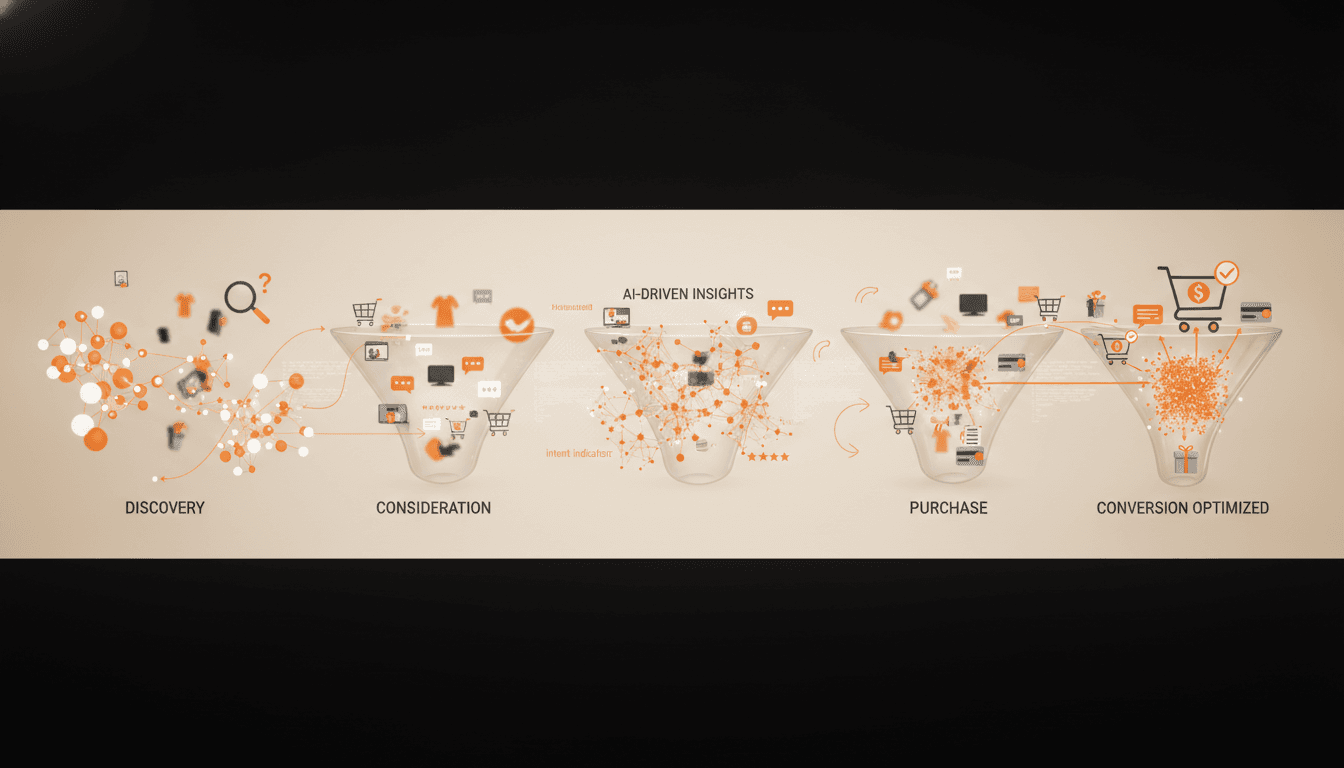
[IMG: Visual funnel diagram showing the five shopper intent types from top to bottom—Informational, Navigational, Commercial Investigation, Transactional, and Situational/Conversational—with example queries and content types mapped to each stage]

User intent classification accounts for approximately **55% of AI recommendation decisions**, according to Gartner's Generative AI in Digital Commerce Report. Understanding the five distinct intent types is the foundation of any effective AI search content strategy. Each one requires a fundamentally different content approach for AI to confidently surface a brand.

**Informational Intent:** Shoppers seeking education, product category guidance, or problem-solving information are not yet ready to buy. A shopper asking "what's the difference between a standing desk and a sit-stand converter" is in full informational mode. Content that performs here includes how-to guides, category explainers, and expert editorial that builds trust and establishes authority.

**Navigational Intent:** Shoppers who already know the brand or product they want are looking for the fastest path to it. These queries are high-conversion but require strong brand presence across structured content touchpoints so AI can confidently route shoppers to the right destination. A direct brand search or product name query falls into this category.

**Commercial Investigation Intent:** Shoppers actively comparing options before making a decision represent arguably the most competitive intent stage, and the one most e-commerce brands underserve. Comparison guides, best-of lists, and detailed specification content perform strongly here. For example, a query like "best standing desks under $500" signals this intent clearly.

**Transactional Intent:** Shoppers ready to purchase are seeking the fastest path to checkout. Product pages, pricing pages, and availability content must be structured so AI can extract and present purchase-ready information without friction. These queries often include words like "buy," "order," or "price."

**Situational/Conversational Intent:** An emerging and increasingly important category, this intent type involves shoppers describing a problem, scenario, or context—"I need a gift for a runner under $50"—and expecting AI to infer the right recommendation. According to Harvard Business Review, this intent type is gaining significant recognition in AI search research as conversational queries become more common.

The data reinforces why full-funnel coverage matters significantly. Adobe Digital Insights found that **70% of AI-assisted shopping sessions begin with an informational or commercial investigation query before transitioning to transactional intent**. Brands must be present and authoritative at the top of the funnel to earn the final recommendation.

Brands that map content to distinct shopper intent stages see up to **30% higher AI recommendation rates**, according to Search Engine Journal. This means content must be robust across multiple intent interpretations—not optimized for a single keyword variation. A content ecosystem needs to speak to all five stages simultaneously.


---


## Why Content Architecture Matters More Than Keywords in AI Search

Knowing the five intent types is only half the battle. The other half is structuring content so AI systems can accurately classify its relevance and extract authoritative product information.

Content structure signals intent relevance far more effectively than keyword density in AI search environments. Unlike traditional search, AI search engines synthesize multiple content sources to form a single recommendation. This means a brand's content must be authoritative, structured, and intent-aligned across multiple touchpoints—not just optimized for a single landing page.

Rand Fishkin, Co-Founder of SparkToro, captures this shift precisely: "AI search doesn't just find products — it makes decisions. And those decisions are based on which brands have built the most credible, intent-aligned content ecosystem. E-commerce teams need to think less like SEOs and more like the AI assistant's trusted advisor."

Here's how **Generative Engine Optimization (GEO)** becomes the operative discipline: GEO is the practice of structuring content so AI assistants can accurately classify intent relevance and extract authoritative product information efficiently. Moz's Generative Engine Optimization Guide confirms that intent-mapped content consistently outperforms generic keyword-optimized copy in AI search environments.

A full content ecosystem—product pages, comparison guides, FAQs, reviews, and editorial—must align with the shopper intent funnel, not operate as disconnected assets. Each piece should reinforce the others, creating a web of credibility that AI systems can recognize and trust.

Google's AI Overviews now appear in over **30% of commercial search queries** in the U.S., according to BrightEdge. Brands that structure product pages, FAQs, and blog content to answer specific intent-stage questions are significantly more likely to be cited by AI assistants, as LLMs favor content that directly resolves the user's underlying goal.


---


## Building an Intent-Aligned Content Strategy for AI Search

[IMG: Content strategy matrix showing content types (guides, comparison pages, FAQs, product pages, reviews) mapped against the five intent stages, with checkmarks indicating strong coverage and gaps highlighted in red]

Understanding the framework is one thing. Building the content strategy that executes it is another. Here's how e-commerce marketing teams can approach intent-aligned content creation systematically.

**Map content to the shopper intent funnel.** Organize content strategy around the progression from awareness → consideration → decision → purchase. Every content asset should have a clearly defined intent stage it serves. This clarity helps both the team and AI systems understand where each piece fits in the customer journey.

**Create distinct content types for each intent stage.** Educational guides and category content serve informational intent. Comparison pages and best-of roundups serve commercial investigation intent. Optimized product pages with structured pricing, availability, and specification data serve transactional intent. Scenario-based content—gift guides, use-case articles, compatibility FAQs—serves situational intent. Variety signals sophistication to AI systems.

**Use consistent, structured formatting.** AI systems need clear structural signals to classify intent and extract product details. Headers, bullet points, structured data markup, and semantic HTML all contribute to how accurately AI systems interpret content relevance. Consistency across a content library amplifies this effect.

**Ensure every piece of content directly answers stage-specific questions.** Amit Singhal, Former SVP of Search at Google, frames this shift precisely: "We are entering a world where the consumer doesn't search for a product — they describe a need, a situation, or a problem, and the AI resolves it with a recommendation. The brands that win will be those whose content answers the need, not just the query."

**Audit existing content for intent alignment gaps.** Most e-commerce brands have strong transactional content (product pages) but significant gaps in informational and commercial investigation coverage. Identifying those gaps is the first step to closing them. A simple spreadsheet mapping the top 100 content pieces to intent stages will reveal patterns quickly.

**Implement structured data and semantic markup.** Schema markup and semantic HTML help AI systems understand content context and relevance, improving the likelihood of appearing in AI-generated recommendation panels. This technical layer amplifies the impact of a content strategy.


---


## The Financial Stakes: Why This Matters Now

The window to establish authority in AI search is open—but it is narrowing rapidly. Statista's AI in E-Commerce Market Forecast projects that global e-commerce sales influenced by AI-powered recommendation engines will reach **$1.2 trillion by 2026**. This makes AI search optimization one of the highest-leverage growth investments available to e-commerce marketing teams.

The early-mover advantage is significant and durable. As AI systems learn from and develop trust in brand content over time, brands that establish intent-aligned content ecosystems now will be increasingly difficult to displace. Clara Shih, CEO of Salesforce AI, captures the stakes clearly: "Generative AI is fundamentally rewriting the rules of product discovery. Intent understanding at scale means that a shopper saying 'I want something cozy for winter evenings' can now receive a highly curated, brand-specific recommendation — and the brands in that recommendation set earned it through strategic content alignment, not ad spend."

The performance data reinforces the urgency. Intent-aligned content strategies deliver up to **30% higher AI recommendation rates**. AI-driven intent recognition improves product matching accuracy by **40%**. With user intent classification driving **55% of AI recommendation decisions**, brands investing in GEO now are building a durable competitive advantage that keyword optimization alone cannot replicate.


---


## Getting Started: Your First Steps Toward AI Search Mastery

[IMG: Step-by-step roadmap graphic showing the six-step process from intent audit through measurement, designed as a clean horizontal workflow for e-commerce marketing teams]

The path to AI search visibility starts with understanding where a brand stands today. Here's how to begin:

- **Conduct an intent audit of current content.** Review the existing content library and assign each piece to an intent stage. Which stages have strong coverage? Which are missing entirely? This audit takes a few hours but provides invaluable clarity on starting position.

- **Identify the top 20–30 shopper questions at each intent stage** in the product category. These questions are the foundation of an intent-aligned content roadmap. Use customer service logs, search data, and social listening tools to surface real questions the audience is asking.

- **Map existing content to intent stages and identify gaps.** Most brands will find significant gaps in commercial investigation content—the stage where AI recommendations are most actively contested. This is typically where the biggest opportunity lies.

- **Prioritize high-impact content creation for underserved intent stages.** Commercial investigation content (comparison guides, best-of lists, detailed use-case content) typically delivers the highest lift for brands with weak mid-funnel coverage. Start here.

- **Implement structured data and semantic markup** across the content ecosystem to help AI systems accurately classify intent and extract product information. This technical layer multiplies the impact of a content strategy.

- **Test and measure.** Track which intent-aligned content pieces drive AI recommendations and correlate those signals with revenue impact. Brands that map content to shopper intent see up to **30% higher AI recommendation rates**—but only if they build the measurement infrastructure to learn from performance data.

AI systems need consistent, structured, intent-mapped content to confidently recommend brands. Content quality and intent alignment matter more than keyword optimization. The brands that internalize this shift now will define the next era of e-commerce discoverability.


---


**Ready to build an intent-aligned content strategy that earns AI recommendations?** GEO specialists help e-commerce brands map their content to shopper intent and capture AI recommendations at every stage of the customer journey. [Book a 30-minute strategy session](https://calendly.com/ramon-joinhexagon/30min) to see how intent-driven content can increase AI recommendation rates by up to 30%.
H
Hexagon Team
Published July 20, 2026