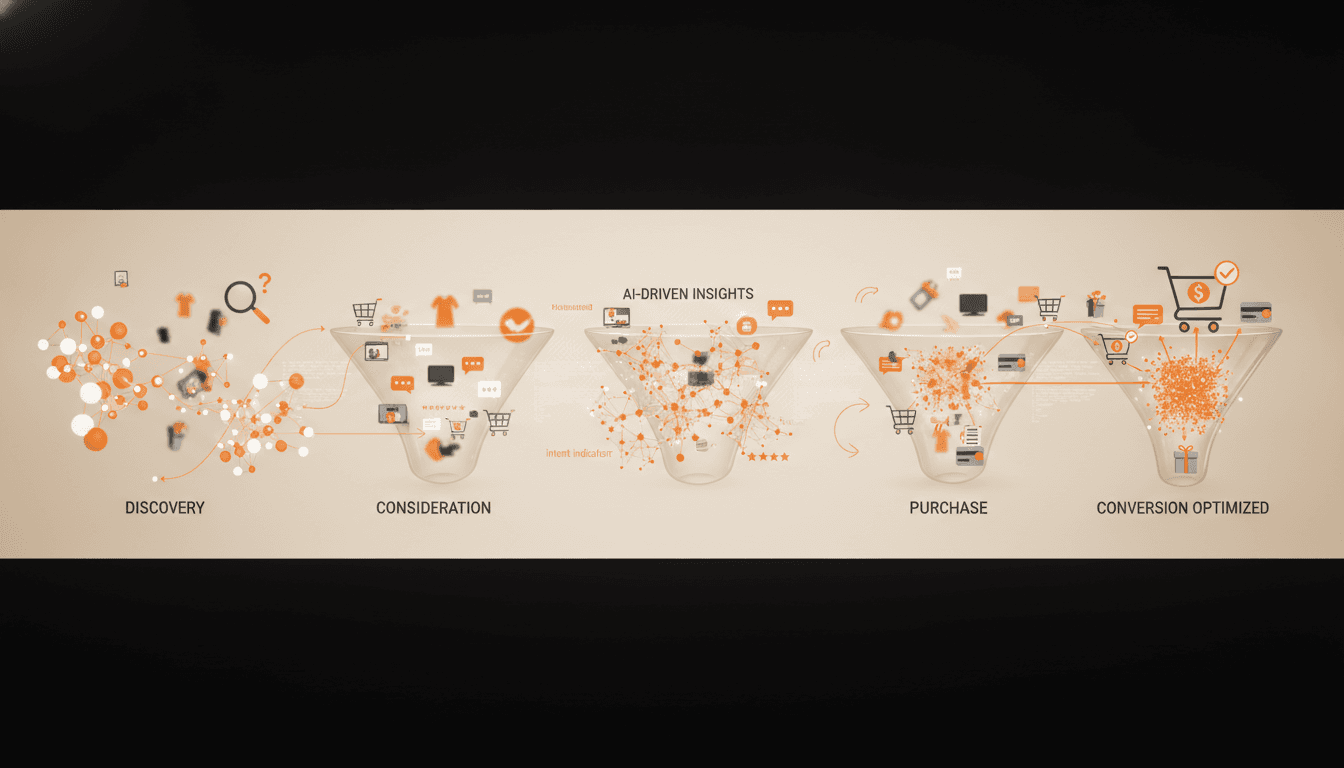
searchcontentproduct
AI Search Intent vs Traditional Keywords: How Consumer Behavior Is Changing in Generative Commerce
Consumer search behavior has undergone a seismic shift. With 69% of AI queries now conversational and a $290 billion market at stake, brands that still optimize for traditional keywords are becoming invisible—while early movers capture 40% higher conversion rates. Here's what's changing, why it matters, and exactly what to do about it.
14 min read
# AI Search Intent vs Traditional Keywords: How Consumer Behavior Is Changing in Generative Commerce

*The search box is dying. With 69% of AI queries now conversational and a $290 billion market at stake, brands still chasing traditional keywords are becoming invisible—while early movers are capturing 40% higher conversion rates. Here's what's changing, why it matters, and exactly what to do about it.*

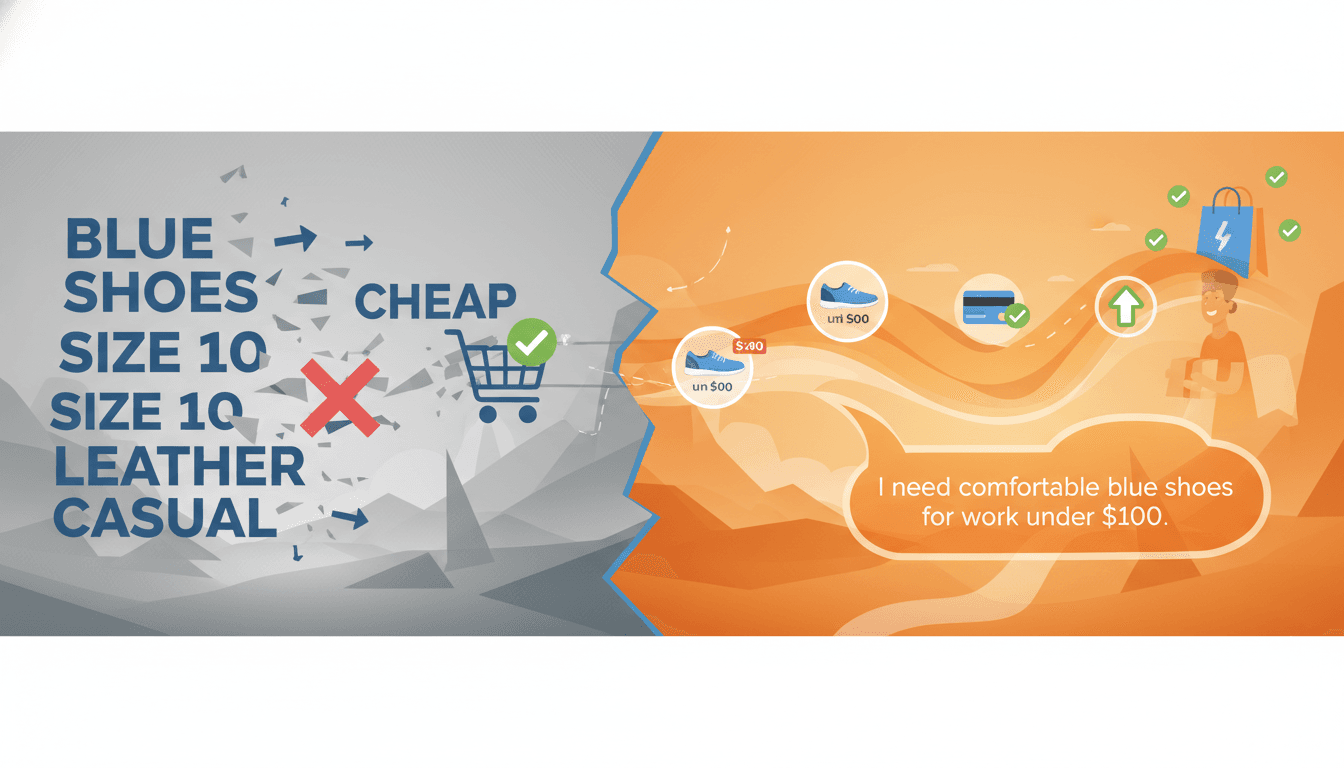
[IMG: Split-screen visual showing a traditional Google search bar with "best running shoes" on the left, versus an AI chat interface with a detailed conversational query on the right, representing the evolution of search behavior]

Two years ago, a consumer typed "best running shoes" into Google. Today, that same person asks an AI: "I have flat feet and run marathons in humid climates—what shoes will prevent injury and keep my feet dry?" That 8-word shift represents a $290 billion market transformation most brands are not prepared for.

While 78% of e-commerce competitors are still optimizing for outdated keyword-based search, early adopters who understand AI search intent are capturing 40% higher conversion rates. This guide shows exactly how to make that shift—and why waiting another quarter could cost market position. The window to establish competitive advantage in AI search is open, but it is closing.


---


## The Anatomy of Search Has Changed: From Keywords to Intent Scenarios

For two decades, search behavior was constrained by the limitations of keyword-based engines. Consumers learned to compress their needs into 2–3 word queries—"running shoes," "waterproof boots," "protein powder"—because that's what the algorithm could process. That compression is over.

Today, [AI search queries average 8–12 words](https://sparktoro.com), describing full scenarios rather than isolated objects. According to [Hexagon's AI Search Behavior Analysis](https://joinhexagon.com), 69% of queries submitted to AI search engines are conversational in structure, compared to only 31% that resemble traditional short-form keyword searches. The scale is staggering: ChatGPT alone processes an estimated 10 million commerce-related queries daily, while generative AI tools collectively handled roughly 13 billion commerce-related queries in 2024—a figure projected to triple by 2027.

This shift runs deeper than query length. Consumers are now externalizing the full context of their needs—their constraints, preferences, use cases, and concerns—because AI tools can actually process that complexity. Brands still optimizing for 2–3 word keywords are structurally invisible in this environment, because their content doesn't address the full scenario an AI needs to make a confident recommendation.

As [Sherry Smith, VP of Commerce Strategy at Publicis Sapient](https://www.publicissapient.com), puts it: "The shift to conversational search is not a trend—it's a structural change in how humans interact with information." For e-commerce, this means the product detail page is no longer just a sales sheet; it's a knowledge document that must anticipate every question a thoughtful AI might ask on behalf of a customer. The brands recognizing this shift as an opportunity—not a disruption—are the ones building durable competitive advantage right now.


---


## What Is Search Intent in the Age of AI? The Four Dimensions Brands Miss

Traditional SEO treats intent as essentially binary: informational (researching) or transactional (buying). AI search engines process four simultaneous intent layers—and brands addressing only one or two will be deprioritized in AI-generated recommendations.

Here's how they break down:

- **Informational intent** — "What is it?" Consumers need education on the product category, how it works, and why it matters to their situation.
- **Navigational intent** — "Where do I get it?" The AI must find the brand and product in its knowledge base to recommend it at all.
- **Transactional intent** — "How much and where do I buy?" Pricing, availability, and purchase friction must be content-accessible so the AI can surface them confidently.
- **Contextual intent** — "Is it right for *my* situation?" This is the dimension most brands miss entirely. The AI needs to match the product's specific attributes to the user's constraints, preferences, and use case.

[IMG: Four-quadrant diagram illustrating the four intent dimensions—Informational, Navigational, Transactional, and Contextual—with example queries and content types mapped to each quadrant]

This four-dimensional framework separates AI search from everything that came before. [AI search engines use large language models to infer latent intent](https://deepmind.google)—the unstated needs behind a query—meaning a question like "best running shoes for bad knees" triggers recommendations based on biomechanics, cushioning technology, and orthopedic endorsements, not keyword matching.

The commercial stakes are significant. [Forrester Research](https://www.forrester.com) found that intent-based AI recommendations convert at rates approximately 40% higher than keyword-triggered results, because they match the full context of a consumer's need rather than a surface-level term. According to [Salesforce's State of the Connected Customer report](https://www.salesforce.com/resources/research-reports/state-of-the-connected-customer/), 84% of consumers trust AI shopping recommendations when the AI explains its reasoning—making contextual accuracy a direct revenue driver, not just a traffic metric.

AI recommendation quality is not a vanity metric. It is a measurable revenue lever that most brands haven't yet learned to pull. The brands that do will capture disproportionate market share as AI search adoption accelerates.


---


## Why Traditional SEO Fails in AI Search (And What Works Instead)

Traditional SEO was built on a specific set of signals: keyword density, backlink authority, domain rating, and metadata optimization. These signals tell a search index what a page is *about*. They do not tell an AI what problem a product *solves*, for whom, or under what conditions.

[Rand Fishkin, Founder of SparkToro and Co-Founder of Moz](https://sparktoro.com), framed the distinction precisely: "In traditional SEO, brands optimized for the algorithm. In AI search, brands are optimizing for understanding." The brands winning in generative search are those who've invested in genuinely explaining their products—who they're for, when to use them, what problems they solve—because that's exactly the information an LLM needs to make a confident recommendation.

The gap between these two disciplines is wide. Only 22% of e-commerce brands have adapted their content strategy for AI search as of early 2025, according to the [Semrush / Conductor State of SEO and AI Search Readiness Report](https://www.semrush.com). That means 78% of the market is producing content that is functionally invisible to the AI engines their customers are increasingly using.

What works instead comes down to three structural shifts:

**Semantic completeness.** Content must answer the full context of a consumer's need, not just surface-level product specifications. The AI needs enough information to understand not just *what* the product is, but *why* it matters.

**Question-answer architecture.** AI engines prioritize FAQ-style content, use-case narratives, and problem-solution framing when evaluating recommendation confidence. These formats directly match how AI systems synthesize information.

**Contextual specificity.** Brands that structure product pages with use-case narratives and problem-solution framing are [3x more likely to be cited in AI-generated shopping recommendations](https://www.semrush.com) than those relying on spec-based descriptions alone.

Keyword stuffing, thin content, and feature-list pages actively harm AI search visibility. They signal to the AI that the content lacks the semantic depth needed to make a confident recommendation—and confident recommendations drive the 40% conversion premium.

The brands winning in AI search right now aren't waiting for their competitors to move first. They're auditing their content, restructuring for conversational intent, and capturing measurable gains in recommendation frequency. For brands ready to understand exactly how their product content performs in AI search engines, a free AI search audit can identify where content is invisible to AI engines and what needs to change.


---


## Conversational Commerce: The Trust Dynamic That Drives 40% Higher Conversions

When an AI recommends a product and explains *why*—citing the specific features that match a user's stated constraints—it generates a level of purchase confidence that keyword-based search has never achieved. This "explainability effect" is the core driver of the 40% conversion premium that [Forrester Research](https://www.forrester.com) attributes to intent-based AI recommendations.

[IMG: Illustration showing an AI chat interface recommending a specific product with a clear explanation of why it matches the user's stated needs, alongside a conversion rate comparison graphic]

Conversational commerce reduces decision friction by pre-answering objections and concerns within the recommendation itself. The consumer doesn't need to visit five product pages, read three reviews, and compare two spec sheets—the AI has already done that synthesis. [Consumers using AI shopping assistants are 2.3x more likely to complete a purchase in a single session](https://www.mckinsey.com) compared to those using traditional search, because AI resolves ambiguity conversationally.

For brands, this creates a specific content imperative: product content must be structured to be "explainable." The AI must be able to cite specific attributes, use cases, and benefits when making a recommendation. This shifts the primary marketing KPI from ranking position to **recommendation frequency**—how often does the AI recommend the product when a relevant consumer query is submitted?

The numbers underscore the urgency. The global conversational commerce market is projected to reach $290 billion by 2025, up from $41 billion in 2021, according to [Juniper Research](https://www.juniperresearch.com). Transparency in AI reasoning isn't just a user experience feature—it is a brand differentiator that separates products the AI recommends confidently from products it overlooks entirely.


---


## The Zero-Click Commerce Threat (And Opportunity) for E-Commerce Brands

Here's a scenario already happening at scale: a consumer asks an AI assistant which protein powder is best for post-workout recovery on a plant-based diet under $40. The AI recommends a specific product, explains why it fits, provides a purchase link—and the consumer never visits a brand website. That is zero-click commerce, and it is restructuring the entire top-of-funnel model.

[ChatGPT reached 100 million weekly active users within two months of launch](https://www.reuters.com) and now processes an estimated 10 million commerce-related queries daily. The scale of this discovery channel is not hypothetical—it is operational and growing. Yet 78% of e-commerce brands have not adapted their content strategy to be visible within it.

The competitive advantage shifts from ranking position to **recommendation frequency**. The question is no longer "does the product appear on page one?" It is "does the AI recommend the product when a relevant consumer asks?" These are fundamentally different optimization targets requiring fundamentally different content strategies.

Zero-click commerce is a threat to brands measuring success exclusively by website traffic. It is an opportunity for brands optimizing for AI citation quality. Content must be structured to be "citable"—the AI must be able to reference specific product details, customer use cases, and quantifiable benefits within its response.

Brands building this content architecture now are building a discovery moat that will compound in value as AI search adoption accelerates. The first-mover advantage window remains open, but the competitive field is filling quickly.


---


## How to Optimize Content for AI Search Intent: A Practical Playbook

The transition from traditional SEO to AI search optimization is not a complete rebuild—it is a strategic restructuring of existing content around the signals that AI engines actually use.

[IMG: Step-by-step visual playbook graphic showing the content restructuring process from traditional keyword-based product pages to AI-optimized, intent-rich content architecture]

**Restructure product pages around questions, not features.** Consumers using AI search are asking questions, and the AI is looking for content that answers them directly. Replace or supplement feature lists with question-answer formats addressing all four intent dimensions. For example, instead of "Waterproof upper," write: "For runners in rainy climates, the waterproof upper keeps feet dry during extended outdoor sessions without sacrificing breathability."

**Build use-case narratives.** Map specific product attributes to specific consumer scenarios. This sentence is citable: "For runners in humid climates, the moisture-wicking upper maintains breathability even during two-hour sessions in high-humidity conditions." A spec list is not.

**Create comprehensive FAQ sections.** [FAQ content, use-case narratives, and problem-solution framing are 3x more likely to appear in AI-generated shopping recommendations](https://www.semrush.com) than spec-based product descriptions. FAQs represent the single highest-leverage content investment for AI search visibility.

Additional content priorities include:

- **Problem-solution framing** — Help AI engines understand when a product *is* and *isn't* the right choice. This builds recommendation confidence by demonstrating nuanced understanding.
- **Quantifiable attributes** — Include specific, measurable product details the AI can cite: weight, dimensions, certifications, test results, clinical endorsements.
- **Comparison content** — Position products relative to alternatives based on consumer needs, not just brand preference.
- **Semantic completeness** — Ensure every product page answers the full context of a consumer's need, not just the surface-level "what is it?" question.

[Greg Brockman, President and Co-Founder of OpenAI](https://openai.com), articulated the underlying principle: "The fundamental unit of AI commerce isn't the keyword—it's the intent." An AI assistant doesn't ask 'what word did the user type?' It asks 'what problem is this person trying to solve, and what constraints are they operating under?' E-commerce brands must start writing product content that answers those questions explicitly.


---


## Generational Urgency: Why Gen Z Is Already Shopping Through AI

The consumer behavior shift described in this guide is not evenly distributed across age groups. Over [58% of Gen Z consumers now initiate at least one product research session per month using a generative AI tool](https://morningconsult.com) rather than a traditional search engine. For this generation, AI-first product discovery is not a novelty—it is the default.

Gen Z will dominate purchasing power within the next decade. Brands that fail to build AI search visibility now will face a structural disadvantage precisely when this generation's spending reaches its peak. The window to establish recommendation authority—to become the brand an AI confidently cites when a Gen Z consumer describes their situation—is open now and closing.

Only 22% of e-commerce brands have adapted their content strategy for AI search as of early 2025. That gap represents a first-mover advantage still available, but the competitive window is measured in months, not years. [Sundar Pichai, CEO of Alphabet](https://abc.xyz), captured the directional shift: "We're moving from search as a lookup tool to search as a conversation partner."

Consumers no longer want to decode their own needs into keywords—they want to describe their situation and have the AI figure out the best solution. Brands that write for humans first, and structure content for AI comprehension second, will own the next decade of discovery. Conversational commerce is adopting faster than any previous commerce technology shift.


---


## Content Optimization Roadmap: What to Do First

The practical question is where to start. Here's a sequenced roadmap that prioritizes high-impact actions within realistic timelines.

**Week 1–2: Content Audit.** Identify which product pages lack semantic completeness and multi-dimensional intent coverage. Prioritize the top 20% of the catalog by revenue and search volume—these pages will generate the highest immediate commercial impact.

**Week 3–8: Restructure Priority Pages.** Rewrite top-priority product pages to address all four intent dimensions. Add FAQ sections, use-case narratives, and problem-solution framing. This phase completes in 4–8 weeks and represents the fastest path to measurable AI recommendation frequency improvement.

**Week 8–12: Build Content Templates.** Create a reusable content template library for semantic completeness so teams can scale this approach across the full product catalog. Once templates are established, the cost per product page drops significantly—making this scalable, not just a one-time investment.

**Ongoing: Monitor Recommendation Frequency.** Shift primary KPI tracking to AI recommendation frequency, not just website traffic and keyword rankings. Brands restructuring content around conversational intent see measurable improvements within 90 days—with some reporting 20–40% increases in AI recommendation frequency after restructuring their top product pages.

The brands building this content infrastructure in 2025 will compound their advantage as AI search adoption accelerates. The investment required now is a fraction of what catch-up will cost in 2027.


---


## Conclusion: The Window Is Open—For Now

The transition from keyword-based search to AI-powered conversational commerce is not a future scenario. It is the present competitive environment, and the gap between brands that have adapted and those that haven't is already generating measurable revenue differences. The 40% conversion premium, the 84% consumer trust advantage, and the 3x recommendation frequency lift are not projections—they are documented outcomes available to brands making the content investment now.

The first-mover advantage window is real, but it is finite. With only 22% of brands currently optimized for AI search, the opportunity to establish recommendation authority before the market catches up remains available. In 12–18 months, AI search optimization will be table stakes. Today, it is a differentiator.

The brands that act now won't just capture higher conversions in the short term—they'll build the content infrastructure, the AI visibility, and the recommendation authority that will define market position for the next decade of commerce. Looking ahead, the competitive landscape will reward those who moved first.
H
Hexagon Team
Published June 5, 2026